 Check the Official RoyaltyShelf AI Offer ↗
Creating a book for Amazon Kindle Direct Publishing can involve much more than writing a manuscript. Depending on the format, a publisher may need to plan the content, prepare illustrations, design the interior, create a cover, check the final files and write a product listing. Bilingual projects add another layer: language accuracy, vocabulary choices, dialect and cultural context all need attention.
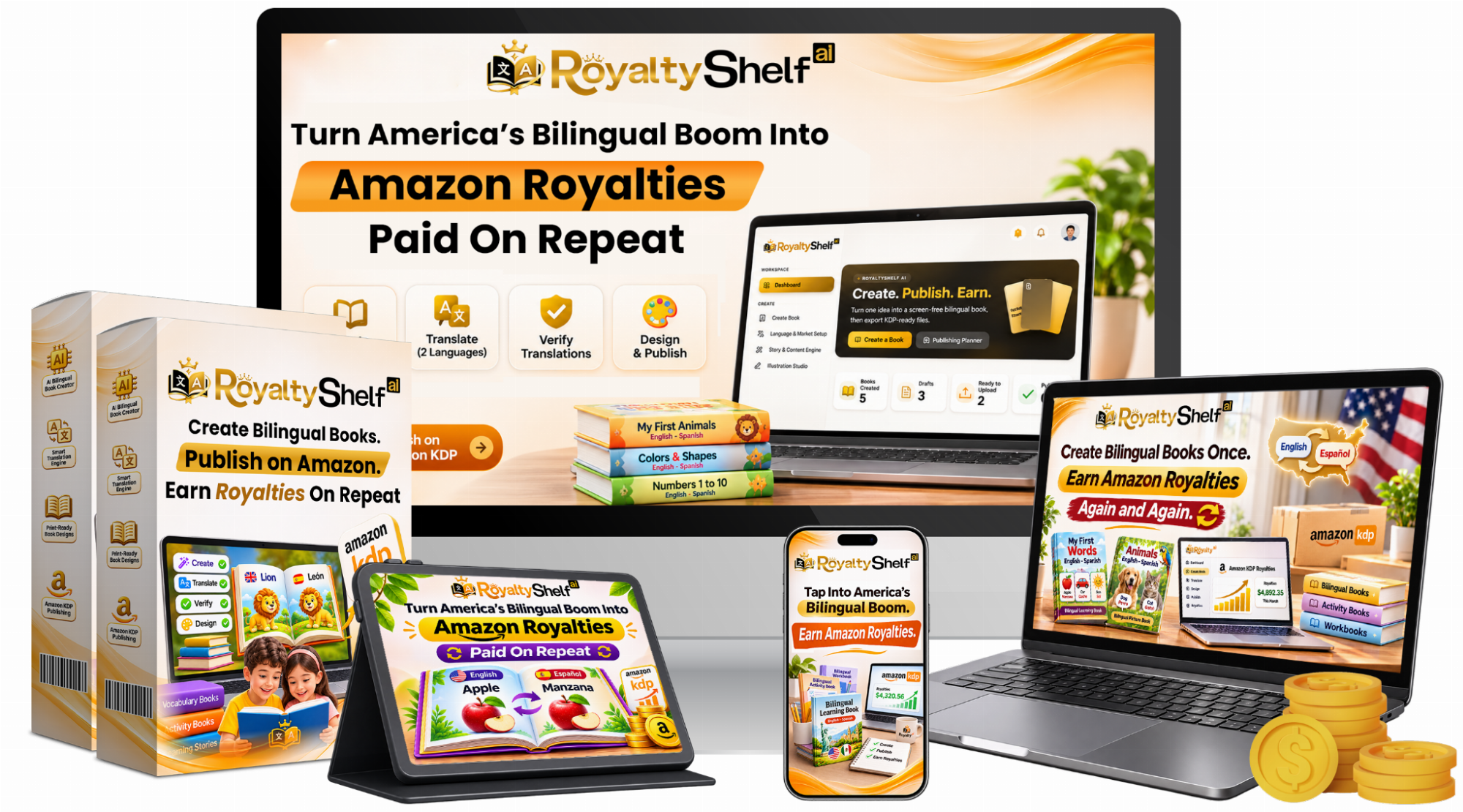
RoyaltyShelf AI is positioned as a tool for bringing several of these tasks into one publishing workflow. Rather than focusing only on long-form writing, it is designed around bilingual books and related publishing assets. This review looks at the product proposition, the features described in its offer, and the practical considerations a KDP publisher should keep in mind.
What Is RoyaltyShelf AI?
RoyaltyShelf AI is an AI-assisted publishing platform focused on creating bilingual books and printable assets. Its advertised formats include children's storybooks, workbooks, coloring books, puzzle books, culture or festival-themed titles and eligible localized PLR content.
The core idea is to guide a creator through several stages: select a book format and language pairing, define the intended reader and layout, generate the material, review the language and visuals, then prepare publishing files and listing copy. The platform describes English paired with Spanish, French, German or Portuguese, alongside dialect options.
That focus may be useful for creators exploring multilingual educational content. It does not remove the need for niche research, editorial judgment or a final human quality review.
How the RoyaltyShelf AI Workflow Works
Select a format, language pair, dialect, age range and intended layout.
Generate story text, learning activities and supporting illustrations.
Check wording, back-translation, reading level, activity answers and page consistency.
Export suitable interiors, covers or printable files and draft marketplace listing details.
This workflow is important because a book is a complete product, not just a block of AI-generated text. A useful creation tool should help the publisher move from an initial concept to files that can be carefully inspected before distribution.
Key Features: What Publishers Should Examine
Bilingual story and content generation
The platform advertises native-language content creation for English paired with four additional languages. It also describes dialect and audience controls. These options could help creators develop books for a more specific reader group than a generic translation workflow would allow.
Back-translation and language review
Back-translation is intended to show an English rendering of generated target-language text. This can help a publisher who does not speak the second language understand the general meaning. Grammar, spelling, dialect consistency and reading-level checks are also advertised. Treat these as review aids, not proof of flawless translation; have a fluent speaker check important commercial content whenever possible.
Illustrations and character consistency
RoyaltyShelf AI describes illustration styles such as watercolor, cartoon, crayon and line art, along with a system intended to keep recurring characters visually recognizable. This matters in picture books because changes in a character's appearance can make a finished story feel inconsistent. Inspect every page at full size and check that images match the text and age group.
Workbooks, tracing and puzzle activities
The advertised activity tools include tracing, word searches, crosswords, matching exercises, mazes and answer keys. For these products, functional accuracy matters as much as visual presentation. Solve each puzzle yourself, compare it with the answer key and check that special characters and accented letters display correctly.
PLR localization and rights records
The platform describes a PLR localizer for adapting eligible licensed content. PLR permissions differ from one source to another: some licenses allow translation and modification while others restrict them. Keep the original license and verify that it expressly permits the intended edits, language versions, distribution channels and commercial use. A software check is not a substitute for reading the license.
KDP exports and listing preparation
Advertised export options include paperback interiors, covers, ebook files and printable PDFs. Listing tools are described as generating titles, subtitles, descriptions, keywords, categories and audience information. These drafts can save preparation time, but publishers should edit them for accuracy and buyer intent. Preview the final interior and cover using the current Amazon KDP tools before submitting.
KDP Publishing: Checks to Make Before Uploading
Automation can reduce repetitive work, but the publisher remains responsible for the finished product. In particular, check these areas before a book goes live:
- AI disclosure: Review Amazon KDP's current rules for disclosing AI-generated text, images and translations when publishing.
- Language quality: Check grammar, meaning, age suitability, cultural references and dialect consistency. Back-translation alone is not enough.
- Interior formatting: Verify trim size, margins, bleed, page order, fonts, image resolution and readability.
- Cover dimensions: Confirm the page count, paper choice, spine width and current cover template requirements.
- Activity functionality: Solve puzzles, trace sample letters and verify every answer key.
- Rights and originality: Confirm permissions for source text, images, fonts and any adapted PLR material. Avoid protected characters, logos and copied content.
- Customer experience: Make sure the title, description, sample pages and actual contents accurately describe what a buyer receives.
RoyaltyShelf AI Pricing: What to Verify
The promotional material supplied for this review advertises a $14 one-time launch price and an optional quick-start upgrade. It also discusses a possible future recurring plan. Promotional prices and checkout terms can change, so the live checkout is the authoritative place to confirm the amount, billing type, included access, credit limits, upgrade terms and refund conditions.
Do not evaluate the offer only by comparing it with the cost of hiring a team. Compare it with your actual needs: how many books you plan to make, how much editing they require, whether the export formats are suitable and whether the time saved justifies the price. A low entry price does not guarantee profitable books.
Pros and Limitations
Specialized bilingual workflow, multiple book formats, language review aids, illustration support, activity generation and publishing preparation in one place.
Translation accuracy, consistency across pages, puzzle correctness, export quality, current license scope, usage limits and actual marketplace demand.
The strongest part of the concept is its specialization. A general AI writer may produce paragraphs, but a publisher still needs to handle images, activities, formatting and listings. Bringing these steps together could make early production more organized.
The main limitation is that generated assets still require quality control. Language checks can miss nuance, illustrations can drift, puzzles can contain errors and a technically valid PDF can still have layout problems. The platform also cannot promise visibility, rankings or sales on Amazon.
Who May Benefit from RoyaltyShelf AI?
It may be worth investigating for KDP publishers interested in bilingual children's books, educators developing supplemental activities, digital-product creators who sell printables, and PLR owners with suitable adaptation rights. Existing publishers may also use the concept to test a new language or format without assembling every production step separately.
It may be less suitable for someone expecting guaranteed royalties, someone who does not intend to review generated content, or a publisher whose project requires specialist translation and illustration beyond what the software can reliably produce.
How to Evaluate It Before Publishing a Full Catalogue
- Choose one narrowly defined reader group and a book idea with a clear learning purpose.
- Create a small sample rather than generating a large catalogue immediately.
- Ask a fluent reviewer to check the second-language text and cultural details.
- Test every illustration, activity, answer key and page layout.
- Export the intended format and inspect it using the current KDP preview process.
- Check rights, disclosure and listing details before publishing.
- Track actual buyer response and improve future books based on evidence.
This measured approach helps you determine whether the workflow is genuinely useful for your publishing process. It also limits wasted effort on books that have not been reviewed or validated.
Frequently Asked Questions
Is RoyaltyShelf AI a general AI writing tool?
It is positioned as a specialized bilingual publishing workflow, with story, workbook, coloring, puzzle and related asset creation features.
Which language pairs are advertised?
The offer describes English paired with Spanish, French, German or Portuguese, with dialect controls. Verify current availability in the live product.
Can it guarantee Amazon KDP approval?
No software can guarantee approval. Review current KDP content, quality, metadata and AI disclosure requirements before submission.
Can I publish AI-generated books?
Amazon KDP permits certain AI-generated content subject to its current policies and disclosure requirements. The publisher remains responsible for rights, quality and compliance.
Does back-translation prove a translation is correct?
No. It can help reveal the general meaning, but it is not a substitute for fluent human review, particularly for books intended for children.
Can I localize any PLR ebook?
No. You must check the specific license. Translation, modification and resale rights vary by source and agreement.
Will creating more books guarantee more royalties?
No. Sales depend on reader demand, quality, competition, discoverability, pricing and customer experience. Publishing volume alone does not guarantee income.
Is the advertised $14 price permanent?
The supplied promotional material describes it as a launch offer. Confirm the current checkout price, billing terms and included features before buying.
Final Verdict: Is RoyaltyShelf AI Worth Exploring?
RoyaltyShelf AI presents an interesting proposition for publishers who want to explore bilingual books and related printable assets. Its advertised combination of content generation, language review, illustrations, activities, KDP exports and listing preparation addresses several stages that normally require separate tools or manual work.
Its value will ultimately depend on the quality of the output and how well it fits your publishing process. Treat the software as a production assistant, not an automatic royalty generator. Start with one useful book, review it carefully, verify the rights and format, and use real market feedback to decide what to create next.
Build Better Books With a Quality-First Workflow
Explore the current RoyaltyShelf AI offer and verify the latest features, price, license and refund terms before making a decision.
Visit the Official RoyaltyShelf AI Offer ↗Affiliate disclosure: This page may contain qualifying affiliate links. We may receive a commission if you buy through them, at no additional cost to you.